The fastest way to
understand any lecture.
Upload your slides and we'll work out what your lecture is trying to teach,
then give you everything you need to understand it first time round.



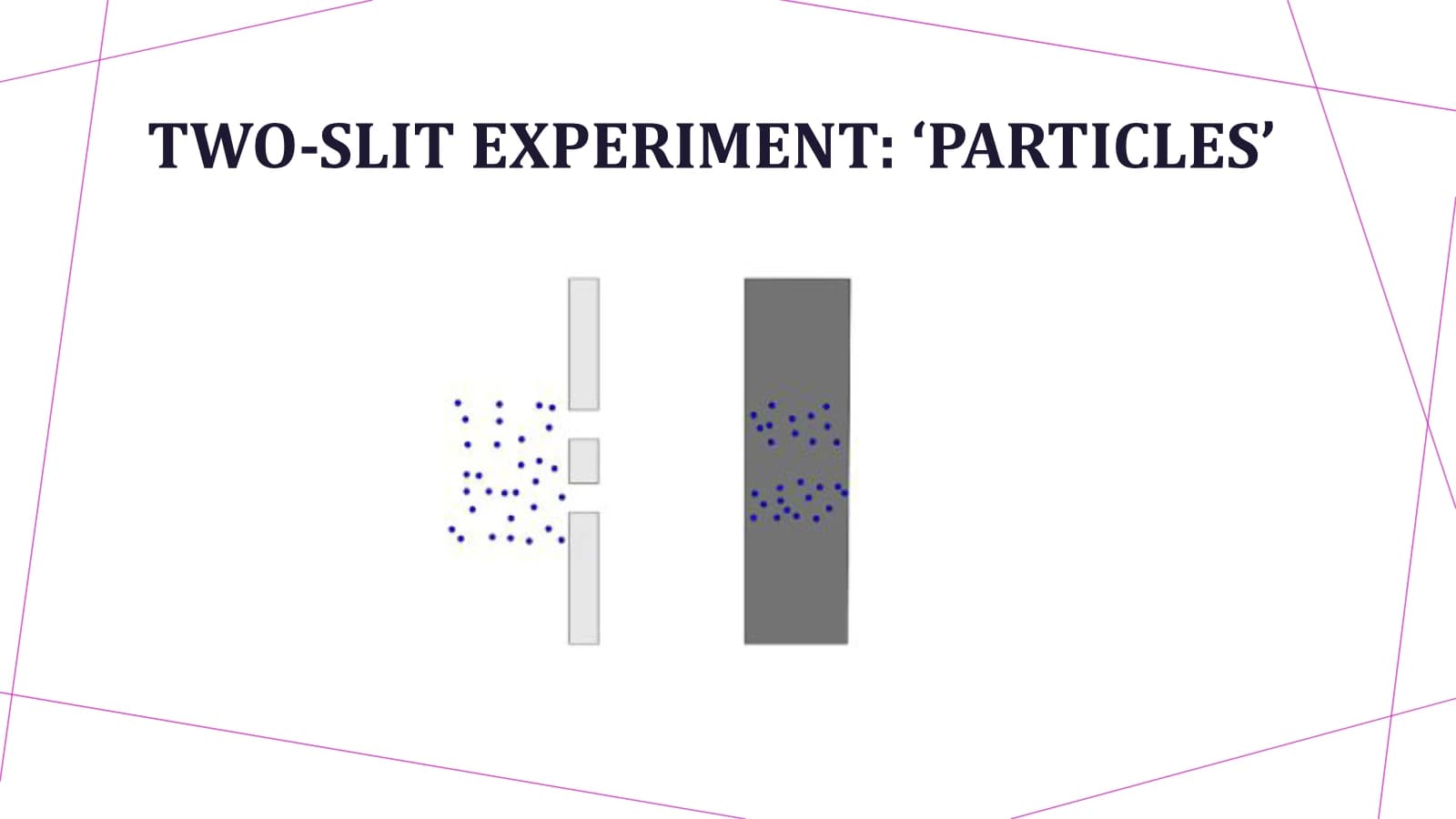

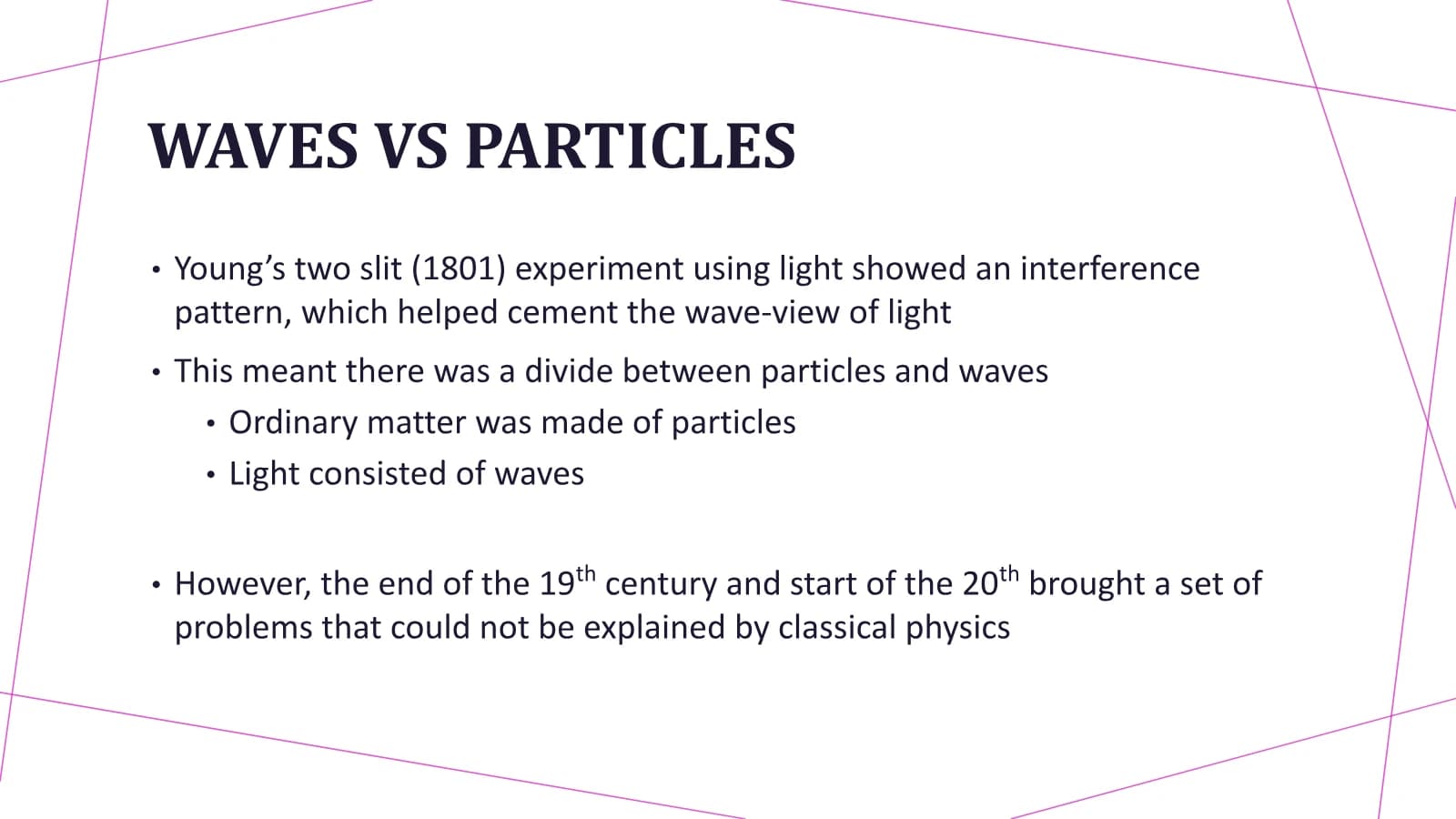



We don't stop at explaining the slides.
Once we've explained your lecture, we'll build everything else you need to practise it, revise it and make it stick.

Every slide, explained
Read each slide with our explanation right beside it, in your module's own notation.

Lessons
We turn your whole lecture into one clear, readable lesson.

Practice questions
Test what you actually understood, with our graded explanations when you get stuck.

Flashcards
We turn the important ideas from your lecture into flashcards ready to review.
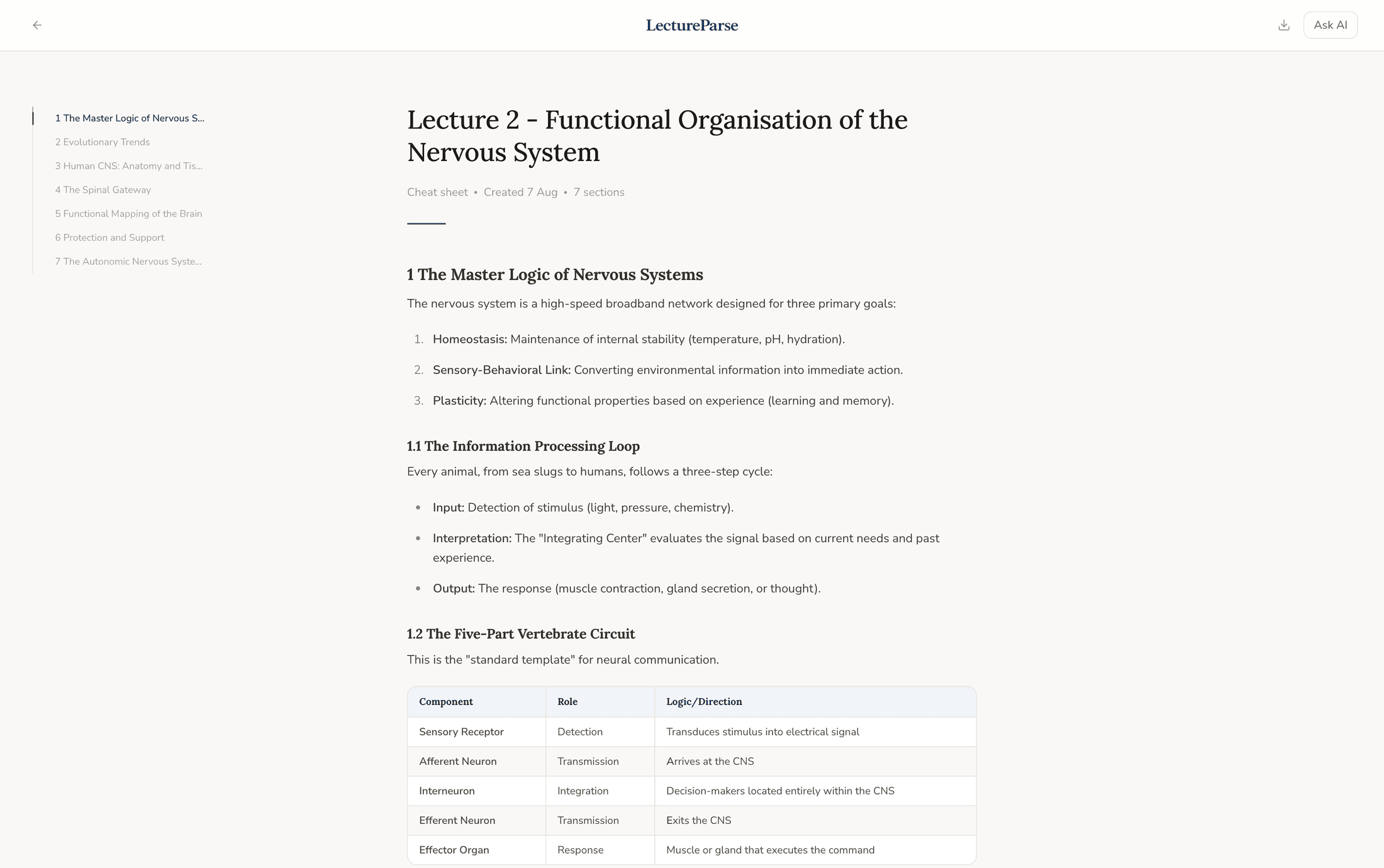
Cheat sheets & summaries
We condense the whole lecture into what you actually need to remember.
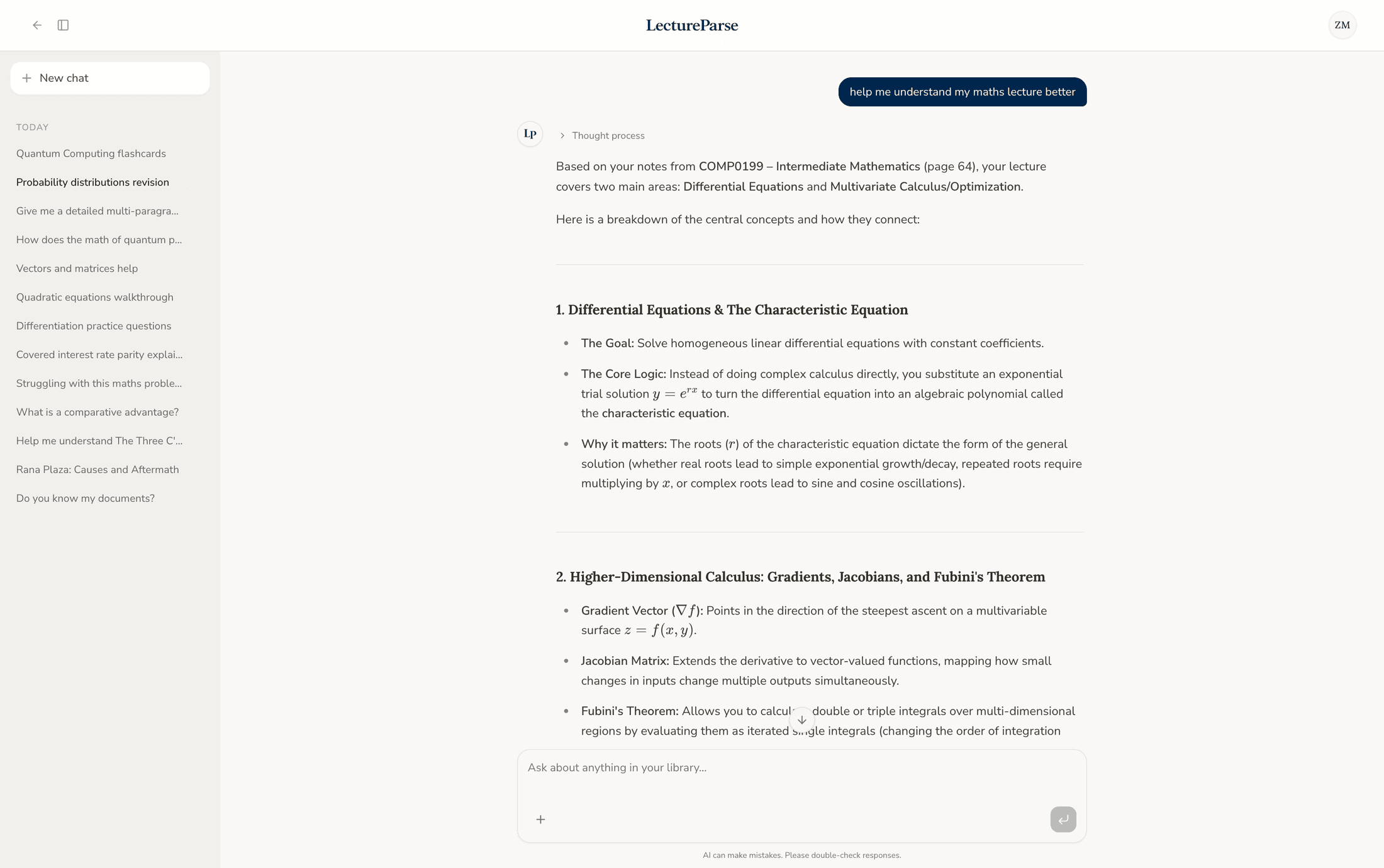
The Companion
Ask anything about your lecture and get an answer from an AI tutor that already understands it.
“I barely watch lecture recordings anymore. The slides with the explanations are usually all I need to catch up.”
Amelia, Biomedical Science student
Course memory.
When an idea from week two comes back in week seven, LectureParse already knows where it came from and why it matters.
Every file you add gives LectureParse more context about what you're studying, so nothing is explained in isolation.
You won't see this map in the app. It's a picture of what happens behind the scenes as LectureParse connects what you upload and keeps the context around it.
Example: one semester of introductory psychology.
Problem sets & exam papers, worked through.
Upload a problem set or past paper and we'll show you how to recognise each question, choose the right approach and get to the answer.
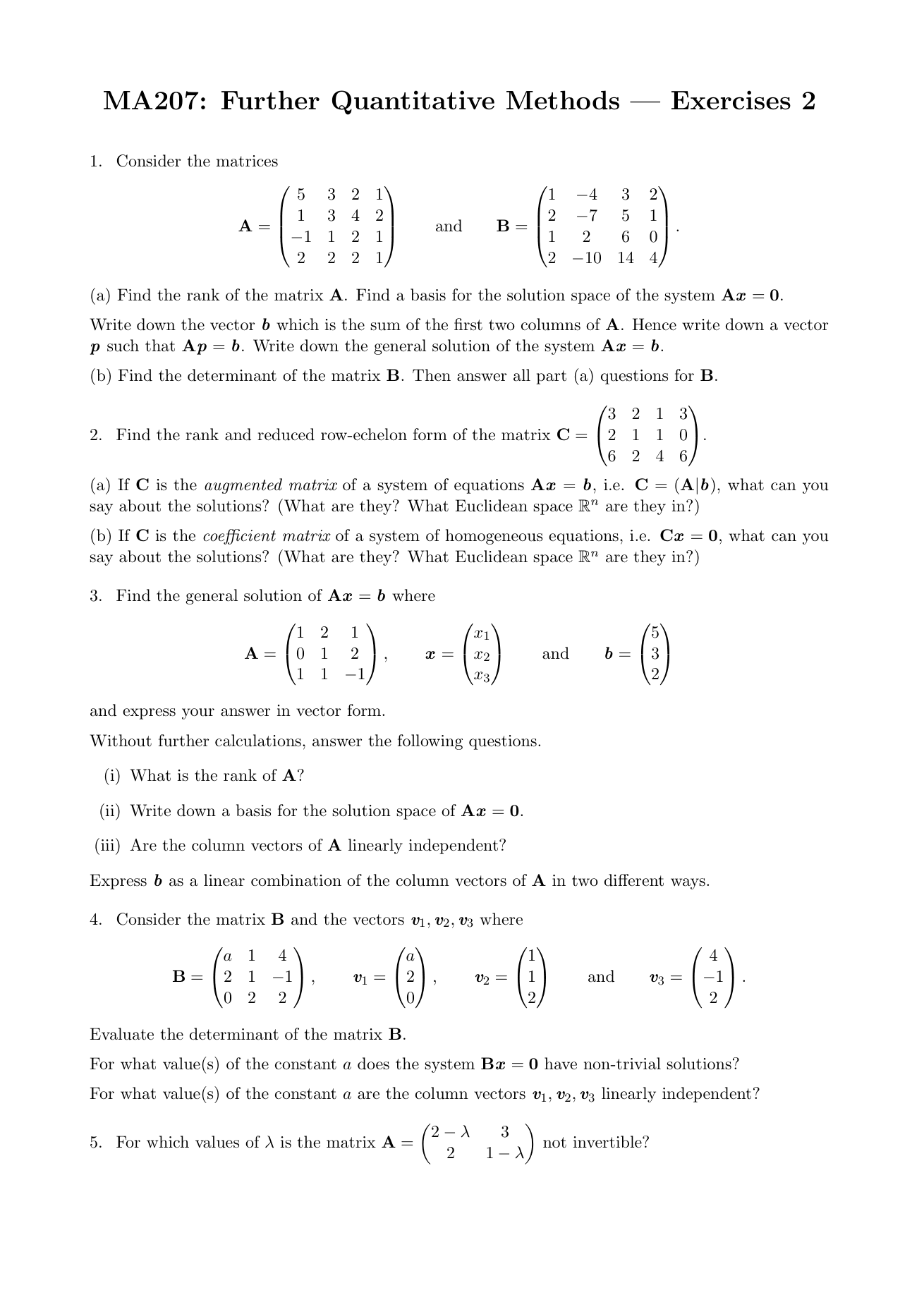
This set covers the fundamental operations of linear algebra, focusing on Row Echelon Form (REF), matrix rank, and solving systems of linear equations ( and ). You will also explore determinants as a tool for checking linear independence and matrix invertibility. Use these notes to master the connection between a matrix's structure and the nature of its solution space. Pay close attention to how a single row reduction reveals the rank, basis, and solvability.
Problem 1(a)
Recognition — You are given a matrix and asked for its rank and null space (the solution space to ). The cue for the rank is the number of non-zero rows after reduction, while the basis for the solution space comes from identifying the “free” variables.
Plan — 1. Reduce matrix to Row Echelon Form (REF).
2. Count the pivots to find the Rank.
3. Express the variables in in terms of free variables to find the basis.
4. Use the definition of matrix-vector multiplication to find and the general solution.
Worked path — To find the rank, we perform row operations. Swapping Row 1 and Row 2 makes the pivot 1, which simplifies the arithmetic:
Now, eliminate the values below the first pivot using , , and :
Notice that , , and are multiples of each other ( and ). This means only two rows are linearly independent.
For the solution space , we have two free variables ( and ) because there are 4 columns and the rank is 2 (). Using , we get the equation . Solving for :
Substitute this into () to solve for :
To find the basis vectors, set to and respectively. Scaling to clear fractions gives the basis vectors.
The vector is the sum of the first two columns, meaning . By the definition of matrix multiplication, this means is a specific solution.
Checkpoint — Rank is 2. Basis for solution space is . Vector . General solution is .
What This Set Is Training
- See a row of zeros in an augmented matrix where the last entry is non-zero → the system is inconsistent (no solution).
- See more columns than the rank → the columns are linearly dependent and has non-trivial solutions.
- Calculate the basis for a solution space → identify free variables in RREF and set them to 1 and 0 sequentially (Problem 1(a), p. 1).
- Relate a specific solution and the null space → the general solution to is always (Problem 3, p. 1).
- Use a determinant to find parameter values for invertibility or independence → set to find where the matrix “collapses” (Problem 4 and 5, p. 1).
Redo Problem 1, p. 1: It covers every major concept—rank, basis, specific solutions, and the general solution—in one go.
Redo Problem 3, p. 1: This is the best test of whether you understand how the solution to and are geometrically related.
Every problem in the set is worked like this — open it in the app to read them all.
Real output — an MA207 Further Quantitative Methods problem set, explained by LectureParse.


“I use it before seminars way more than I expected. I can go back through the lecture pretty quickly and actually remember enough to have something to say when I get there.”
Sofia R.BSc EconomicsYou're probably wondering.
Anything else, just ask.